Prices
Prices are in credits. Most operations charge per row: one returned item, such as a filing, file, form, document, objection letter, requirement, NAIC row or OSHA row. Reading a single item is one row. Searches, employer matching and NAIC operations also charge a request fee once per call that returns data.Filings
Files
Carriers (NAIC)
Regulatory documents
OSHA
Objections
Operations not in these tables, such as the carrier, group, MGA and product directory,
/users/me
and the filing workspace, have no API usage charge. Files that belong to
your organization are free to read, download and extract text from.
Free doesn’t mean open. Product access, dataset terms and permissions still apply, as described in
Product access. Workflows that run agents, such as
pre-review and objection
triage, use credits for their own work.
How charges are counted
- You pay for returned rows, not
limit.limitcaps the size of a page; a page with 50 rows costs the same withlimit=50orlimit=200. - Empty results are free, including the per-request part of the price.
- Errors are free, including invalid requests, permission denials, missing data and rate limits. See Errors.
- Each successful request is charged. Sending the same request again, or fetching the next page, is another charge. If you lose a response and send the request again, you pay for both.
- Each download is charged.
downloadFilecharges when it returns a signed URL, whether or not you fetch it. Requesting a new URL for the same file is another download. - Text is charged per chunk. Reading the next chunk of a long document is another chunk.
- Agents pay the same. A call through the Effective MCP server costs the same as the same call over HTTP; there is no extra fee.
- Usage belongs to the key’s owner. Charges come from your organization’s credits and are recorded against the person who owns the API key, whoever or whatever uses it.
Examples
See what a request cost
Every charged response has anX-Effective-Credits header with its cost in credits. Free responses
don’t have one.
Response headers (abbreviated)
credits.
See your credit spend in Effective
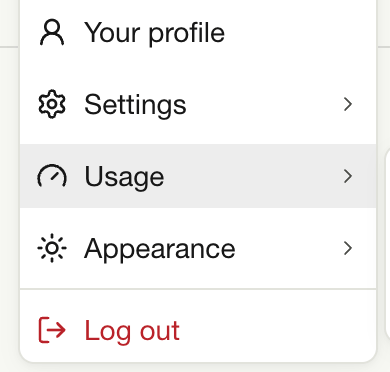
To see the credits you’ve used, click your name at the bottom of the sidebar in Effective, then select Usage.